The pace of change in digital advertising is accelerating rapidly, and Google Ads changes in 2026 are among the most significant updates businesses have seen in recent years. With the increasing role of automation and artificial intelligence, traditional pay-per-click (PPC) methods are evolving into highly data-driven, machine-led systems.
Over the past few years, Google Ads updates in 2026 have focused heavily on improving automation, enhancing user privacy, and simplifying campaign management. Many of the Google Ads new features introduced recently are designed to help advertisers achieve better results while reducing manual work.
For businesses that rely on paid advertising to generate leads, sales, or brand awareness, adapting to these changes is no longer optional. Those who understand and implement modern Google Ads strategies early will maintain a competitive advantage, while those who ignore the updates risk falling behind.
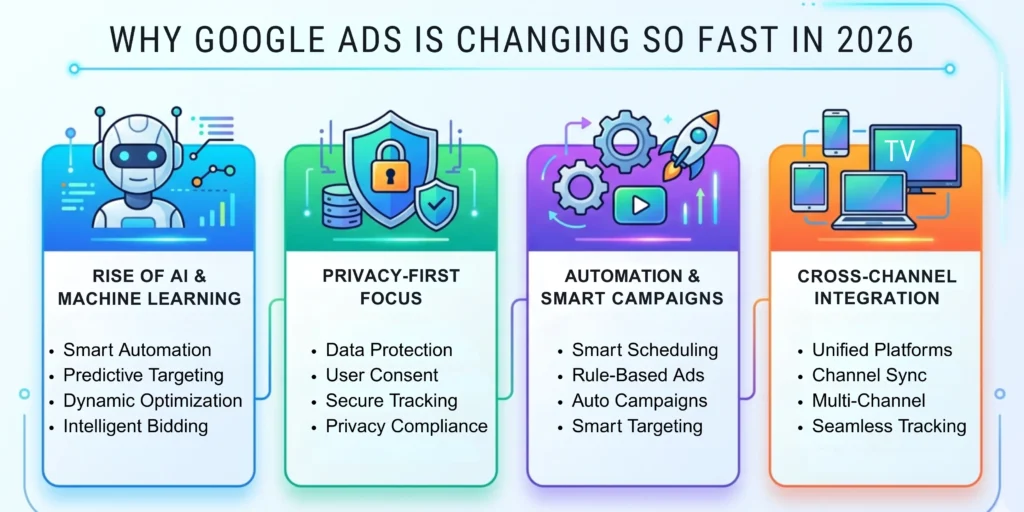
Why Google Ads Is Changing So Fast in 2026
The rapid transformation of advertising platforms is largely driven by technology, data privacy requirements, and changing consumer behavior. Understanding Google Ads trends in 2026 helps businesses prepare for long-term success.
Role of Artificial Intelligence
Artificial intelligence has become the foundation of modern advertising systems. Today, AI in Google Ads is used to analyze massive datasets in real time and determine which ads should be shown to specific users.
Machine learning models evaluate user behavior patterns, browsing history, device usage, and engagement signals to predict purchase intent. Instead of relying solely on manual keyword targeting, AI helps identify the most valuable audiences and optimizes campaigns automatically.
AI also enhances ad relevance by dynamically adjusting messaging, visuals, and targeting criteria. This improves click-through rates, conversion rates, and overall return on investment (ROI). As technology continues to evolve, AI-driven campaign management will become even more accurate and efficient.
Shift Toward Automation
Another major trend in automation in Google Ads is the reduction of manual campaign management. Advertisers are now encouraged to rely on automated bidding, targeting, and asset generation systems.
Automation reduces human errors and speeds up decision-making. For example, automated bidding systems adjust bids based on performance signals, such as device type, time of day, and location.
Although automation simplifies workflows, businesses must still monitor campaigns carefully. Human oversight remains essential to ensure that campaign objectives align with business goals.
Privacy and Cookieless Advertising
Privacy regulations are reshaping how advertising platforms collect and use data. With third-party cookies being phased out, advertisers must rely on first-party data and consent-based tracking systems.
This transition supports a more transparent advertising ecosystem, but it also requires businesses to rethink their targeting strategies. Collecting user data ethically and securely will become a core component of successful advertising campaigns.
12 Big Google Ads Changes in 2026 You Must Know
Understanding these major updates helps businesses prepare for the evolving digital landscape.
AI-Powered Campaign Optimization
One of the biggest AI-powered Google Ads developments is automated campaign optimization. AI now handles tasks such as audience selection, budget allocation, and bid adjustments. This ensures campaigns perform efficiently with minimal manual effort.
Performance Max Becoming Default
The performance max 2026 format is becoming the preferred campaign type. It allows advertisers to run ads across multiple Google platforms, including search, display, video, and shopping, from a single campaign structure.
Intent-Based Targeting Replacing Keywords
Traditional keyword targeting is gradually being replaced by intent-based targeting. Instead of matching exact keywords, Google Ads now focuses on user behavior signals and search intent.
First-Party Data Is Now Essential
The importance of first-party data in Google Ads has increased significantly. Businesses must collect customer information through websites, apps, and CRM systems to maintain targeting accuracy.
Automation of Ad Creatives
Modern automated ad Google features allow platforms to generate headlines, descriptions, and visuals automatically. These tools test multiple variations to identify the most effective combinations.
New Reporting Transparency Features
Recent Google Ads reporting updates provide deeper insights into campaign performance. Advertisers can now view detailed audience interactions and conversion paths.
Smart Bidding Improvements
The latest smart bidding updates improve cost efficiency by using predictive modeling. These models estimate the likelihood of conversions and adjust bids accordingly.
Changes in Ad Policies
Google has introduced simplified advertising policies that prioritize automation-friendly formats. Older campaign structures are gradually being phased out.
Video and Asset Automation
Video content plays a growing role in advertising. Automated systems now generate video ads using existing brand assets, making video campaigns more accessible.
AI Shopping Experiences
AI-driven shopping campaigns personalize product recommendations and improve customer engagement. These experiences integrate seamlessly with e-commerce platforms.
Reduced Manual Control
Manual adjustments are decreasing as automation takes over many campaign elements. While this reduces complexity, it also requires businesses to trust algorithm-driven decisions.
New Account Structures
The Google Ads account structure 2026 emphasizes simplified campaign hierarchies. Fewer manual settings and more automation-driven controls define the new structure.
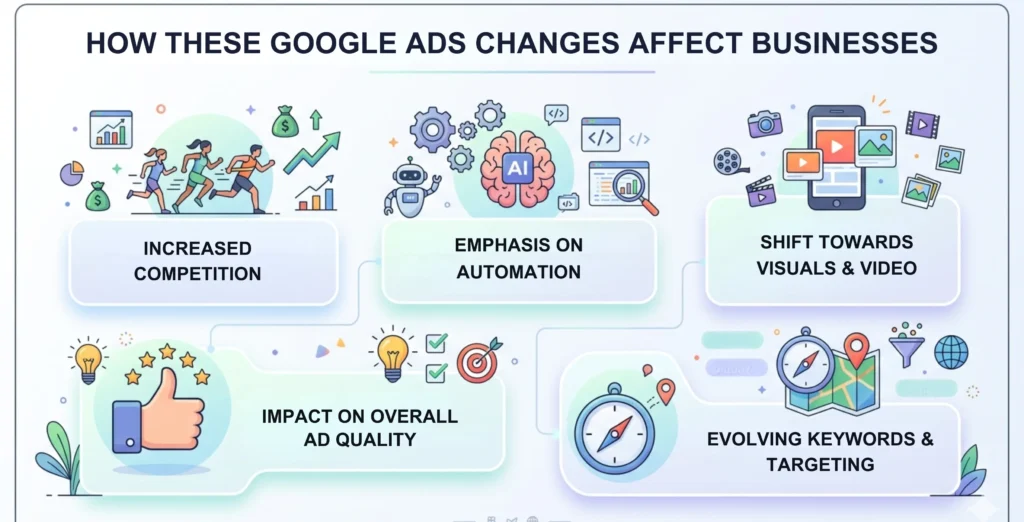
How These Google Ads Changes Affect Businesses
The impact of Google Ads changes varies depending on the size and type of business. Understanding these differences helps organizations adjust their strategies effectively.
Impact on Small Businesses
Small businesses may initially find automation challenging, especially if they lack technical expertise. However, automation tools also reduce the need for large marketing teams.
By using simplified campaign structures and automated bidding systems, small businesses can achieve competitive performance without extensive manual management.
Investing in proper tracking systems and collecting customer data becomes especially important for smaller companies with limited budgets.
Impact on E-commerce Brands
The Google Ads business impact on e-commerce brands is particularly significant. AI-powered shopping campaigns allow online stores to deliver personalized product recommendations to customers.
Automation also helps e-commerce brands manage large inventories efficiently. Dynamic product feeds, automated creatives, and predictive bidding improve overall campaign performance.
E-commerce businesses that embrace video ads and visual content will gain additional advantages in customer engagement.
Impact on Service-Based Businesses
Service-based businesses, such as agencies and consultants, rely heavily on lead generation campaigns. Automation helps identify high-intent audiences more accurately.
Location-based targeting and call tracking features improve lead quality. However, service providers must focus on strong landing pages and clear messaging to convert visitors into customers.
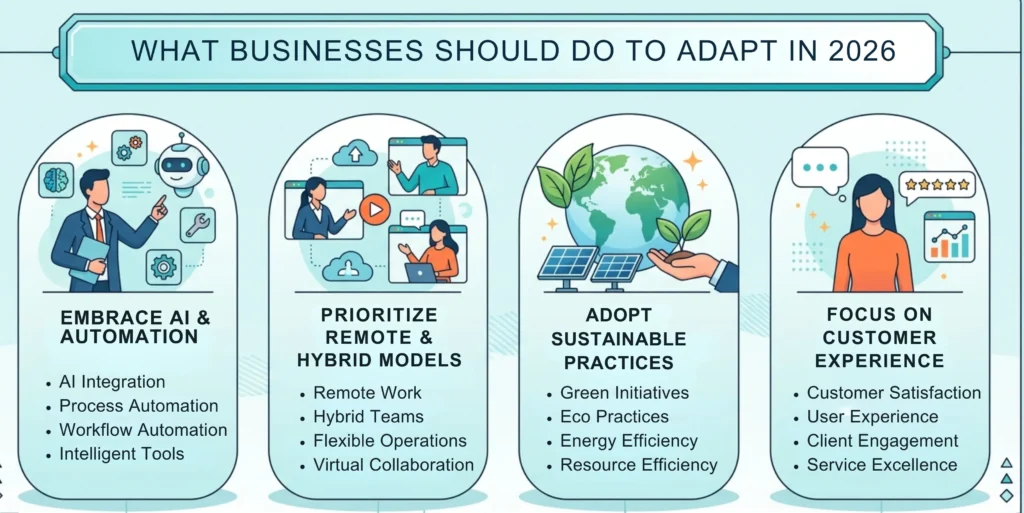
What Businesses Should Do to Adapt in 2026
Developing an effective Google Ads strategy for 2026 requires careful planning and consistent optimization. Businesses that adapt early gain long-term advantages.
Focus on Conversion Tracking
Accurate conversion tracking is essential for campaign optimization. Businesses should track actions such as purchases, form submissions, and phone calls.
Without proper tracking, automated systems cannot evaluate campaign performance effectively.
Build Strong First-Party Data
Collecting customer data through email subscriptions, registrations, and loyalty programs strengthens targeting capabilities.
This data becomes increasingly valuable as privacy regulations limit third-party tracking.
Improve Creative Assets
High-quality visuals, videos, and copy improve engagement rates. Businesses should invest in professional ad creatives and continuously test new variations.
Use Automation Strategically
Automation should be used as a support tool rather than a replacement for strategic planning. Businesses must monitor campaign results and adjust goals accordingly.
Regular Campaign Audits
Routine audits help identify performance gaps and optimization opportunities. Reviewing campaign signals, data accuracy, and return on investment ensures long-term success.
Common Mistakes Businesses Will Make in 2026
Avoiding Google Ads mistakes in 2026 helps businesses maximize advertising performance.
One common mistake is ignoring automation tools. Many businesses hesitate to adopt automated systems, missing opportunities to improve efficiency.
Another mistake involves poor tracking setup. Without reliable conversion tracking, campaigns cannot deliver accurate performance insights.
Weak data signals also reduce campaign effectiveness. Businesses that fail to collect and maintain high-quality data struggle to achieve consistent results.
Overlooking creative quality is another frequent error. Poor visuals and messaging lead to low engagement rates and wasted advertising budgets.
Future Predictions for Google Ads Beyond 2026
The future of Google Ads will likely include deeper integration of artificial intelligence and predictive technologies.
Fully AI-driven campaigns will automate nearly every aspect of advertising. Advertisers will define goals, while algorithms manage execution.
Voice search advertising is expected to grow as smart assistants become more widely used. Businesses will need to optimize content for conversational queries.
Predictive targeting will become more accurate, enabling ads to reach users before they actively search for products or services.
These Google Ads trends and future developments will reshape how businesses connect with customers.
Conclusion
The Google Ads changes in 2026 represent a major shift toward automation, artificial intelligence, and privacy-focused advertising. Businesses that understand these trends and adapt early will gain a competitive advantage.
Staying updated with new tools, improving data collection methods, and investing in creative assets are essential steps for long-term success. While automation simplifies campaign management, strategic oversight remains critical.
Companies that embrace modern advertising practices will not only survive these changes but also thrive in an increasingly competitive digital environment.
FAQ
What are the biggest Google Ads updates in 2026?
Major updates include AI-powered optimization, Performance Max campaigns, stronger automation tools, and privacy-focused targeting methods.
Is Google Ads still worth it in 2026?
Yes, Google Ads remains highly effective when campaigns are optimized with automation, quality data, and strong targeting strategies.
How does AI affect Google Ads?
AI improves targeting, bidding, and performance while automating repetitive tasks to increase efficiency and results.